

Artists: Andrea Büttner, Maja Hodošček in collaboration with Barbara Kukovec, Neža Knez, Eva Koťátková
Curator: Irena Borić
Exhibition opening: 10. 12. 2026, 19.00
Exhibition program:
19. 12. 2026, 12.00: guided tour with curator Irena Borić
8. 1. 2027, 17.00: guided tour with curator Irena Borić
The exhibition Versifying Dreams reflects on how we position ourselves in relation to our immediate surroundings and how our bodies experience them. How do we respond to the overwhelming demands of everyday life, whether political circumstances, the consequences of climate change, pressures at work or traumatic personal events? And how do our bodies respond? Can the mind attend to a body that refuses to move or react, a body that stiffens and comes to a halt, clearly signalling: Enough! Or do we ignore it and continue on autopilot, as though nothing has happened? When, and before whom, do we bow our heads? Do we bow before a small, delicate creature or the unyielding force of authority? What do we do when we are backed into a corner? And where, at such moments, might a temporary space of freedom emerge?
The “dreams” in the exhibition’s title suggest a space beyond the familiar, limiting physical world – one that also encompasses everything we overlook or seek to avoid. Dreams offer clues to our state of mind and open up a realm of imagination. Poetry, meanwhile, allows us to (re)create the events of our dreams. The exhibition highlights artistic poetics that, either gently or humorously, undermine structures of dominance. It explores the “power of bending” not as an act of submission but as a means of moving beyond prescribed possibilities.
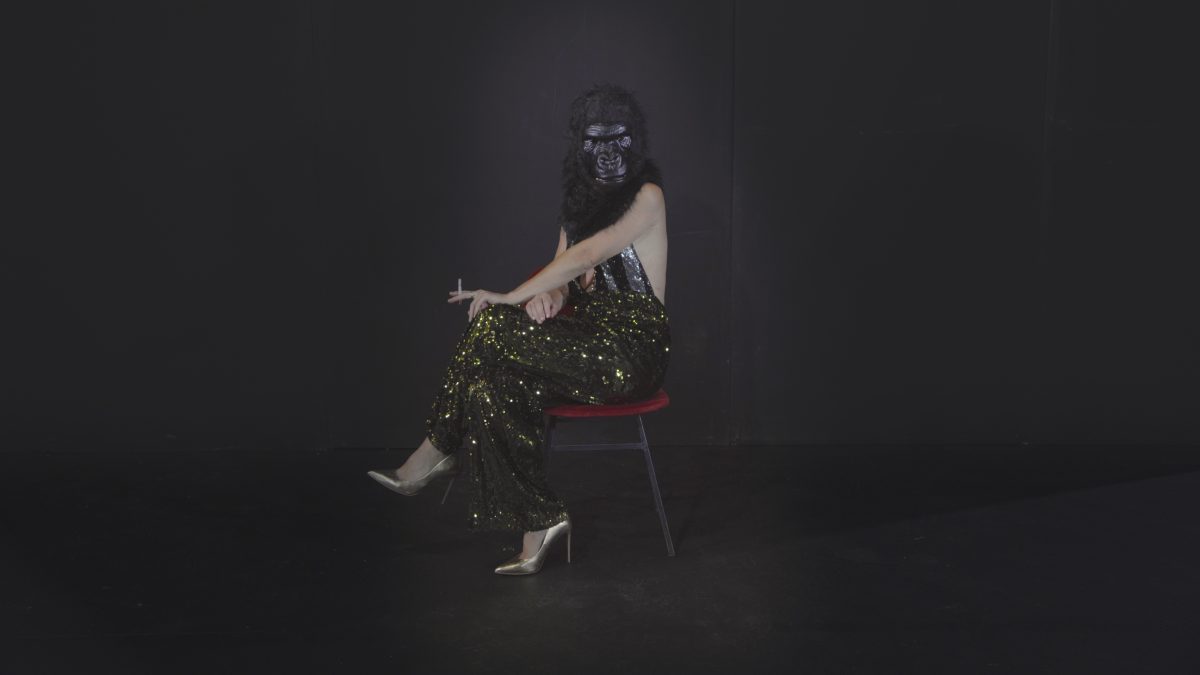
We live and operate within an economy of visibility in which attention is a valuable commodity, usable as currency. More eyes mean more likes, more views and more (symbolic) capital – all fiercely contested by influencers and corporations alike. The longer the gaze lasts, the better, particularly in a world of visual overload where attention is increasingly fleeting. And it is precisely this struggle for attention that lies at the heart of Stay With Me, 2026, a multichannel video installation by Maja Hodošček, created in collaboration with actress and performer Barbara Kukovec. The work puts our attention to the test as two characters address us from separate screens: one uses politeness, warmth and almost hypnotic powers of persuasion, while the other constantly interrupts through monkey-like behaviour. Here, Hodošček draws on Gorillas in Our Midst, a 1999 study by Daniel Simons and Christopher Chabris demonstrating how readily we overlook unexpected or unusual events when our attention is directed elsewhere.[1] In the video, the gorilla serves both as a distraction and as a companion. As we follow it from screen to screen, it attracts, diverts and redirects our gaze while also inviting us to remain present in that (distracting) moment.
Andrea Büttner also prompts us to reflect on attention from a slightly different angle in her work Stereoscopic slideshow from the Whitehouse collection (mosses and field trips), 2014. These are photographs from a collection of stereoscopic slides created by biologists Harold and Patricia Whitehouse during their research into mosses and liverworts. The artist examines the act of gathering moss, about which the biologist Robin Wall Kimmerer writes: “Mosses and other tiny creatures invite us to set aside our usual perceptions, at least for a while. They ask of us only one thing – attention.”[2] Moss is most often described in terms of what it lacks: it is a plant without flowers, fruits, seeds or roots. Since it is readily classified as a “lower”, and therefore supposedly inferior, form of plant life, the body language captured in these photographs is all the more striking as the human being bends down and crawls before the moss. Drawing on Georges Bataille’s concept of l’informe (the formless), Büttner initially approached moss from a sculptural perspective. She then explored how falling and the pull of gravity might transcend the boundaries of form, stability and authority. Through references to hierarchies of “high” and “low” art, the artist also examines the discourse on poverty and wealth.
Eva Koťátková understands the body as a reflection of various psychological states; in her series of staged black-and-white photographs, Not How People Move, But What Moves Them, 2012–13, she shows figures caught in the act of struggling to free themselves from the pressures of ideology, society, architecture, relationships and so on. In her grandmother’s empty flat, she photographed her own body trapped in patterns of repetitive movements. She then transformed each of these into a collage, adding figures whose seemingly unrestricted movements contrast with the passivity of the photographed body. It is as though a world of imagination has opened up, or a possibility for coming to terms with one’s own confinement. The artist found inspiration in the German choreographer Pina Bausch, who sought to portray “people as they really are”. By exploring the intimate dimensions of life, Koťátková reveals how they are shaped by social forces and how bodily movements are not simply practical, automatic or autonomous, but also expressions of inner experience.
While Eva Koťátková puts herself in the familiar space of her grandmother’s former flat, Neža Knez turns, through sustained research and experimentation, to a wider environment bound up with her family history. Her experimental film Through These Same Pores, the Same Sweat Still Flows, 2026, concludes an artistic research project that also included Through These Same Pores, the Same Sweat Still Flows, Experiment 2 (Circulations). As we listen to the main narrative, based on correspondence between the artist and her aunt, Knez takes us on a journey through time in which camera views, artistic and other materials, light, sounds and created images flow together. We follow the characters only occasionally, merely as a reminder that this place leaves its mark on all its (former) inhabitants, human and more-than-human. They are all part of it, yet they are all guests. The film’s multilayered quality is evident in the medium itself, through the interplay of light, darkness, sound and filming techniques, while the spoken text remains sufficiently open for us to situate it within our own sense of place.
[1] Gorillas in Our Midst: Sustained Inattentional Blindness for Dynamic Events (popularly known as the invisible gorilla experiment).
[2] Gathering Moss: A Natural and Cultural History of Mosses (2003); her book is available in Slovenian as Obilje in vzajemnost v naravnem svetu (2025).
Biographies:
Andrea Büttner lives and works in Berlin and is Professor of Painting and Drawing at the Academy of Fine Arts in Munich. Her practice brings art history into dialogue with social and ethical questions, exploring themes including poverty, labour, community, faith, botany and philosophy. She was nominated for the Turner Prize and received the Max Mara Art Prize for Women. In 2025, she won an international art competition for Cologne Cathedral.
Maja Hodošček’s art practice is based on process and experimentation, with a focus on performance, behaviour and ways of learning. She completed her Master’s degree at the Dutch Art Institute in Arnhem and studied Gestalt psychotherapy at the GITA Institute in Ljubljana. She received the national Rihard Jakopič Award for artistic achievement (2020) and the OHO Award (2010).
Eva Koťátková is concerned with social, institutional and physical structures of everyday life: the rules and constraints that shape how we think, learn, move, behave and create. Her installations immerse the viewer in unfamiliar environments, opening up new sensory experiences and perspectives. She co-founded the Institute of Anxiety, a platform that sees anxiety as a consequence of social, political, economic and ecological forces.
Neža Knez combines visual art, performative practices and the fields of experimental film and analogue practices. She actively collaborates with other artists. She also leads workshops and regularly works with the Zagreb-based film collectives Studio Pangolin and Klubvizija. She has received several awards.
Slovenian proofreading: Inge Pangos
English translation: Arven Šakti Kralj
Leaflet design: Lea Jelenko
Photos from the opening: Simão Bess
Exhibition view: Matic Pandel
The Škuc Gallery programme is supported by the Ministry of Culture and the Municipality of Ljubljana.

